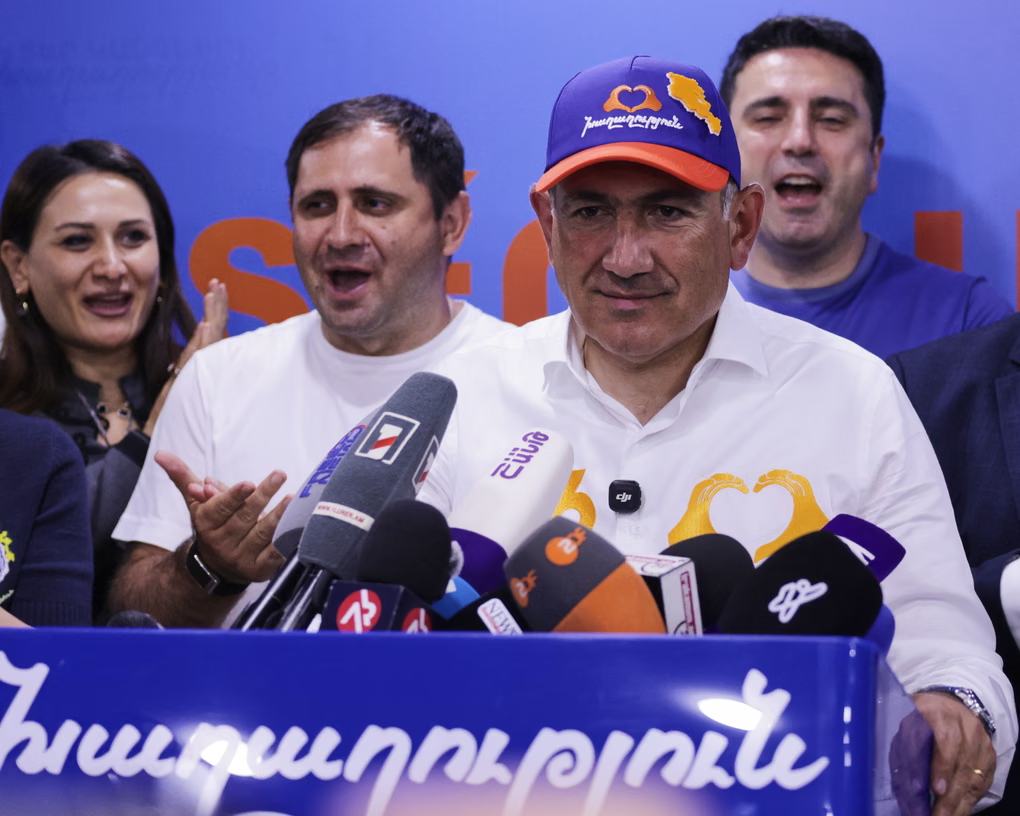
Yerevan, Armenia: Armenia’s ruling pro-European party has secured victory in parliamentary elections, reinforcing the country’s strategic pivot toward Europe and further distancing itself from its longtime ally, Russia.
Final election results showed Prime Minister Nikol Pashinyan’s Civil Contract party winning a narrow parliamentary majority, while the opposition Strong Armenia alliance, led by Russian-Armenian billionaire Samvel Karapetyan, captured approximately 25 percent of seats.
The outcome is expected to be welcomed by European leaders while causing concern in Moscow, as it strengthens Pashinyan’s mandate to pursue closer ties with the West, finalize a peace agreement with neighboring Azerbaijan, and normalize relations with Turkey.
Pashinyan Declares Vote a Mandate for Peace
Speaking to supporters as results emerged, Pashinyan said the election reflected Armenians’ desire for peace and regional cooperation.
“The people of Armenia voted for peace, regional prosperity, and regional cooperation,” he said. “I hope this will receive a positive response from Turkey and Azerbaijan.”
The prime minister reaffirmed his commitment to deepening relations with Europe while maintaining Armenia’s membership in the Russia-led Eurasian Economic Union, signaling an attempt to balance competing geopolitical interests.
Europe Welcomes Armenia’s Pro-Western Direction
European leaders quickly congratulated Pashinyan on his victory.
Ursula von der Leyen praised the election result as evidence of a democratic Armenia moving closer to Europe.
“Armenia can count on us,” she wrote in a message congratulating the Armenian government.
Pashinyan also received support from Donald Trump, who reportedly described him as “a great friend and leader.” The United States has played an increasingly active role in mediating peace negotiations between Armenia and Azerbaijan.
Election Held in Shadow of Nagorno-Karabakh Loss
The vote marked Armenia’s first national election since the loss of Nagorno-Karabakh to Azerbaijan in 2023, ending more than three decades of Armenian control over the disputed territory.
Opposition groups campaigned heavily on the issue, accusing Pashinyan of failing to defend Armenian interests and surrendering historic lands.
However, Pashinyan argued that Armenia’s long-standing pursuit of Nagorno-Karabakh trapped the country in a cycle of conflict, economic isolation, and dependence on Russia. He has portrayed peace with Azerbaijan as the foundation for a more secure and prosperous future.
Constitutional Hurdles Remain
Despite his victory, Pashinyan failed to secure the parliamentary supermajority required to amend Armenia’s constitution.
This presents a significant obstacle because Azerbaijan has demanded the removal of constitutional language that it claims implies Armenian territorial claims over Nagorno-Karabakh. Baku considers constitutional reform a key condition for signing a final peace treaty.
Political analysts say the issue could complicate efforts to achieve a lasting settlement between the two countries.
Voters Back Stability Over Confrontation
Many voters cited peace and economic development as key reasons for supporting the government.
Lilit Mkrtchyan, a shopkeeper in Yerevan, said Armenians were exhausted by decades of conflict.
“We want to be an open, European country that develops and prospers,” she said. “I don’t want to worry about my son being called up to fight.”
The sentiment reflects growing public support for stability and economic growth after years of regional tensions.
Relations With Russia Continue to Deteriorate
Pashinyan’s pro-Western course has increasingly strained relations with Russia.
Many Armenians became disillusioned with Moscow after Russian peacekeepers failed to prevent Azerbaijan’s takeover of Nagorno-Karabakh. The fallout prompted Armenia to suspend participation in the Russia-led Collective Security Treaty Organization (CSTO), marking the deepest rupture in bilateral relations since independence.
In the lead-up to the election, Vladimir Putin warned that Armenia was following a path similar to Ukraine’s closer integration with the West.
Armenian officials also accused Russia of attempting to influence the election through disinformation campaigns and support for pro-Russian candidates.
Moscow has recently imposed a series of trade restrictions affecting Armenian exports, including fruit, fish, flowers, and the country’s internationally recognized brandy industry.
Economic Growth Supports Government Popularity
Despite geopolitical challenges, Armenia has experienced strong economic growth in recent years, driven in part by the arrival of Russian businesses and capital following Russia’s invasion of Ukraine.
The economic expansion has enabled Pashinyan’s government to invest heavily in infrastructure and regional development projects, helping maintain support outside major urban centers.
However, critics argue that Pashinyan has increasingly centralized power and adopted a more personalized style of governance.
Opposition Raises Concerns Over Democracy
Human rights advocates and opposition figures have voiced concerns about democratic standards during the campaign.
Several opposition members, including allies of Samvel Karapetyan, were arrested on charges ranging from vote-buying and financial crimes to alleged attempts to overthrow the government.
Karapetyan himself was detained in June and charged with advocating the seizure of power. He conducted much of his campaign while under house arrest.
After the election, Pashinyan pledged to continue dismantling what he described as Armenia’s “criminal-oligarchic system” and indicated that senior opposition figures could face further legal scrutiny.
Balancing Reform, Peace, and National Identity
While many Armenians support normalization with Turkey and Azerbaijan, others remain skeptical.
Karen Grigoryan, a doctor who voted for Karapetyan, said reconciliation should not come at the expense of historical memory.
“We can’t just be friendly with Turkey and pretend the past is erased,” he said, referring to the mass killings of Armenians during the Ottoman era, which Armenia and many Western nations recognize as genocide.
Political analysts note that despite criticism of Pashinyan, many voters viewed the opposition as even less appealing due to its close ties with Russia.
As commentator Tatul Hakobyan observed, many Armenians appeared to choose what they saw as the more viable option.
“People are choosing the lesser of two evils,” he said. “The alternatives to Pashinyan are much worse.”
Armenia’s Strategic Future at a Crossroads
The election result represents more than a domestic political victory for Pashinyan. It signals Armenia’s continued effort to redefine its place in the South Caucasus by pursuing peace with its neighbors, expanding ties with Europe, and reducing dependence on Russia.
Whether that strategy delivers long-term security, economic prosperity, and political stability will likely shape Armenia’s future for years to come.
This version is optimized for search engines with strong focus keywords such as Armenia election, Nikol Pashinyan, Armenia Europe relations, Russia-Armenia tensions, Nagorno-Karabakh, Azerbaijan peace deal, and South Caucasus politics, while maintaining a professional international news style.