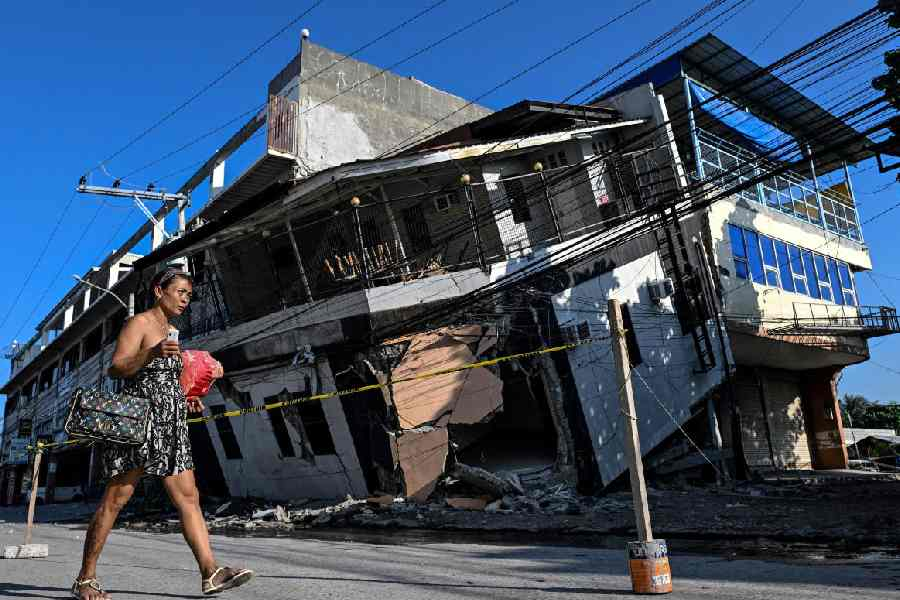
Manila: Rescue teams continued searching through collapsed buildings in the southern Philippines on Tuesday, a day after one of the country’s most powerful earthquakes in decades killed at least 37 people, injured hundreds, and forced more than 20,000 residents from their homes.
The powerful 7.8-magnitude earthquake struck off the coast of Mindanao on Monday morning, triggering tsunami warnings across the region and causing widespread destruction in several provinces.
Officials said only four people remain officially listed as missing, but emergency responders are conducting detailed inspections of damaged structures amid concerns that additional victims could still be trapped under debris.
Rescue Operations Continue Amid Devastation
Search and rescue teams worked through the night in some of the hardest-hit areas, including the city of General Santos, where several buildings collapsed during the quake.
Regional fire officer Edgar Tanawan, who is overseeing rescue efforts, said two people were pulled alive from a damaged commercial building housing a grocery store and other businesses. However, one person was found dead, while rescuers continue efforts to locate two others believed to be trapped inside.
Advanced scanning equipment has so far detected no signs of life beneath the rubble, officials said.
Outside the damaged building, families anxiously awaited updates on their loved ones.
“It’s difficult to accept as a mother that my son is still trapped there,” said 65-year-old Dioslinda Deluvio. “My only wish is that he is brought out today so we can finally have peace.”
Thousands Displaced After Powerful Quake
The earthquake’s epicentre was located approximately 20 kilometres off the coast of Sarangani province. Strong tremors were felt across Mindanao and even reached parts of Indonesia, including the city of Manado on Sulawesi Island.
According to disaster management authorities, nearly 500 people were injured and more than 20,000 residents were displaced, with many taking shelter in evacuation centres and temporary camps.
Fear of a tsunami prompted thousands to flee coastal communities shortly after the earthquake struck.
Although tsunami waves measuring up to 1.4 metres above normal tide levels were recorded in parts of the Philippines, reported damage was relatively limited. Authorities confirmed that six stilt houses in a coastal village were damaged, while smaller waves were observed in Indonesia, Palau and southern Japan.
General Santos Declares State of Calamity
Authorities declared a state of calamity in General Santos City, home to more than 700,000 residents, after significant damage was reported across the area.
Images from the city showed collapsed buildings, cracked roads, and debris-covered streets tangled with fallen utility poles and power lines.
Government agencies have begun large-scale assessments of damaged infrastructure while working to restore electricity and water services to affected communities.
Officials expressed hope that the death toll would not rise further as rescue operations continued.
Schools and Hospitals Sustain Damage
The earthquake caused extensive damage to schools and healthcare facilities across the region.
Schools that had reopened on Monday following a lengthy break were ordered closed while authorities inspect buildings for structural safety.
Rafaelito Alejandro, head of the Office of Civil Defense, said thousands of school buildings suffered varying degrees of damage, ranging from minor cracks to severe structural issues.
Videos circulating online showed terrified students scrambling to evacuate classrooms as buildings shook violently. In one widely shared clip, children can be seen clinging to teachers before rushing to safety as a temporary shelter collapsed nearby.
Hospitals also faced major challenges in the aftermath of the disaster.
In General Santos and Sarangani, medical teams treated patients in temporary tents while engineers inspected hospital buildings for structural integrity.
Health Secretary Teodoro Herbosa said restoring electricity remains a priority, as power outages have disrupted access to critical medical equipment and specialized treatments.
Strong Aftershocks Keep Residents on Edge
The Philippine Institute of Volcanology and Seismology (Phivolcs) recorded at least 23 strong aftershocks following the main quake.
The most powerful aftershock measured magnitude 6.7, prompting many residents to spend the night in evacuation centres rather than return to their homes.
Authorities warned that additional aftershocks remain possible and urged residents to stay alert.
Philippines Remains Highly Vulnerable to Earthquakes
The Philippines lies along the Pacific Ring of Fire, one of the world’s most seismically active regions. The country experiences hundreds of earthquakes each year due to its location along multiple tectonic plate boundaries.
The latest disaster comes just eight months after a magnitude 6.9 earthquake struck near the central island of Cebu, killing 79 people and becoming the country’s deadliest seismic event in more than a decade.
As rescue efforts continue, authorities are focusing on locating any remaining survivors, providing relief to displaced families, and assessing the full scale of the destruction caused by one of the strongest earthquakes to hit the Philippines in the last 50 years.